
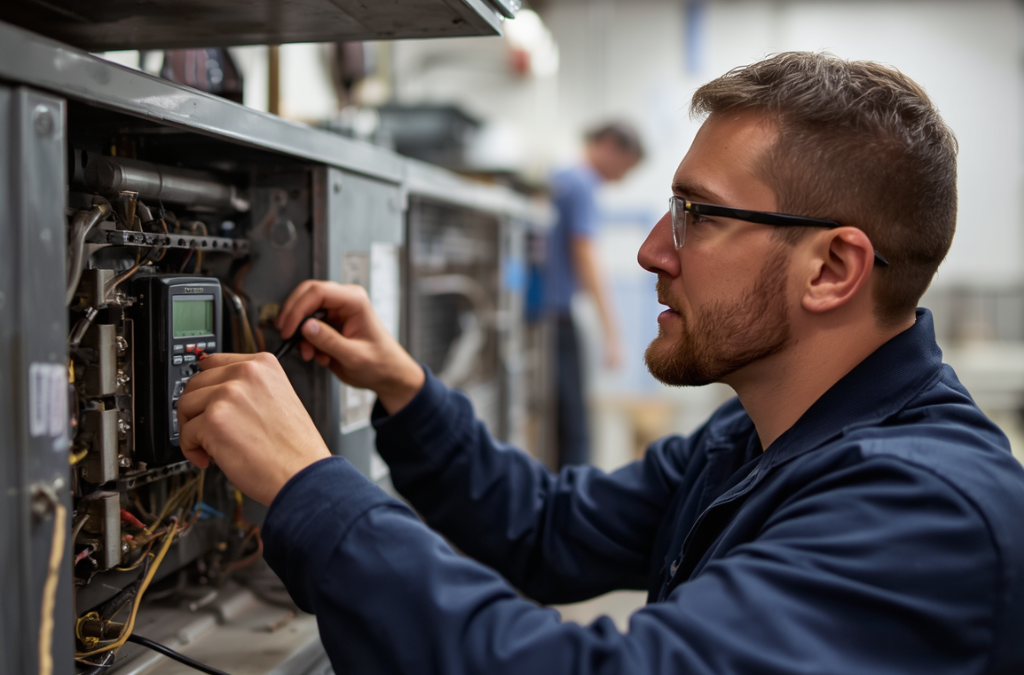
Quick answer: HVAC and electrical skills go hand in hand because nearly every heating and cooling system runs on electrical power. Technicians who understand both wiring and refrigeration can diagnose problems faster, work more safely, and take on higher-paying jobs. Cross-training in both fields makes you a more valuable, versatile tradesperson.
Walk onto any job site where a furnace won’t start or an air conditioner keeps tripping a breaker, and you’ll see a simple truth: heating, cooling, and electricity are deeply connected. A technician who only knows one side of the equation often hits a wall. The thermostat won’t fire the system, the capacitor’s gone bad, or the wiring isn’t up to code—and suddenly the job requires skills that overlap two trades.
That’s why so many of the strongest technicians in the field carry knowledge of both HVAC systems and electrical work. The two disciplines feed into each other constantly. Understanding how they connect can shape the way you approach your career, your training, and your earning potential.
This post breaks down exactly how HVAC and electrical skills work together, why employers value people who have both, and how the right HVAC training in South Jersey can set you up for long-term success.
Key Takeaways
- Almost every HVAC system depends on electrical components, so technicians who understand both trades can troubleshoot faster and work more safely.
- Combining HVAC and electrical knowledge opens the door to more job opportunities, higher pay, and greater flexibility on the job site.
- Quality HVAC training in South Jersey teaches both the mechanical and electrical sides of the trade, preparing students for real-world work.
Why HVAC and electrical skills are so closely linked
Modern heating and cooling systems are essentially electrical machines that move heat. Think about what happens inside a typical unit:
- A thermostat sends a low-voltage signal to start the system.
- A compressor and motors draw significant electrical current to run.
- Capacitors and contactors manage the flow of power to those motors.
- Control boards act as the brain, directing each component on when to switch on and off.
When any of these electrical parts fail, the whole system stops working—even if the mechanical components are in perfect shape. A technician who can read a wiring diagram and test voltage with a multimeter will find the fault quickly. Someone without that knowledge may replace the wrong part or call in a separate electrician, which costs time and money.
What electrical problems do HVAC technicians run into?
HVAC technicians deal with electrical issues nearly every day. Some of the most common include:
Faulty capacitors and contactors
Capacitors store the energy needed to start motors. When they fail, the system may hum but won’t turn on. Knowing how to safely discharge and test a capacitor is a core electrical skill.
Tripped breakers and wiring faults
An air conditioner that keeps tripping the breaker usually points to an electrical problem—a short, an overloaded circuit, or a failing motor pulling too much current. Tracing that fault requires real electrical know-how.
Thermostat and low-voltage wiring
Modern smart thermostats rely on precise low-voltage wiring. A single miswired terminal can stop a system from heating or cooling, so technicians need to understand control circuits.
Control board failures
Today’s systems are packed with electronics. Reading error codes and testing control boards calls for comfort with both diagnostics and electrical theory.
How does cross-training improve safety on the job?
Electricity is dangerous when it isn’t respected. High-voltage components can cause serious injury or worse. A technician trained in both HVAC and electrical work understands:
- How to safely shut off and lock out power before starting a repair.
- How to test for live current before touching components.
- How to follow electrical code requirements to keep installations safe and legal.
This knowledge protects the technician, the customer, and the property. Employers know that a worker who treats electricity with the right caution is a worker they can trust on any job.
What career benefits come from learning both trades?
Combining HVAC and electrical skills makes you far more valuable in the job market. Here’s why it pays off:
More job opportunities. Companies prefer technicians who can handle the full scope of a service call without bringing in extra help. A versatile technician gets hired and stays busy.
Higher earning potential. Specialized skills command higher wages. When you can troubleshoot both the mechanical and electrical sides of a system, you bring more value—and you can charge for it.
Greater flexibility. Some seasons are busier for heating and cooling, while electrical work stays steady year-round. Knowing both gives you options when work slows down in one area.
A faster path to advancement. Technicians who understand the whole system are often the first considered for lead positions, supervisory roles, or running their own business down the road.
How HVAC training in South Jersey prepares you for real-world work
The best way to build these overlapping skills is through hands-on training that covers both sides of the trade. At South Jersey Trade School, students don’t just learn theory in a classroom—they practice on real equipment that mirrors what they’ll find in the field.
Quality HVAC training in South Jersey should teach you how to:
- Read and interpret wiring diagrams and schematics.
- Safely test and replace electrical components like capacitors, contactors, and motors.
- Diagnose system failures using multimeters and other diagnostic tools.
- Understand refrigeration cycles alongside the electrical systems that power them.
- Follow safety procedures and electrical code standards.
By learning the mechanical and electrical sides together, students graduate ready to handle the kinds of problems employers actually face. That preparation translates into confidence on day one of the job.
Building a career that connects two trades
HVAC and electrical work aren’t separate worlds—they’re two halves of the same skill set. Every system you’ll service depends on the steady flow of electricity, and the technicians who understand that connection are the ones who solve problems fastest, work safest, and earn the most.
If you’re ready to build a career that combines both, the next step is finding training that teaches the complete picture. Explore the HVAC training in South Jersey programs at South Jersey Trade School and start working toward a skilled trade with real demand and real growth.
Frequently Asked Questions
Do HVAC technicians need to know electrical work?
Yes. Nearly every HVAC system relies on electrical components like thermostats, capacitors, motors, and control boards. Technicians who understand electrical systems can diagnose and repair problems more quickly and safely than those who only know the mechanical side.
Is HVAC training the same as electrical training?
No, but the two overlap heavily. HVAC training focuses on heating, cooling, and refrigeration systems, while electrical training covers wiring and power. Strong HVAC programs include electrical instruction because the trades are so closely connected in the field.
How long does HVAC training take in South Jersey?
Program length varies by school and format, but many HVAC training programs can be completed in under a year. Contact South Jersey Trade School directly for details on course length and schedules.
Will learning both HVAC and electrical skills help me earn more?
In most cases, yes. Technicians who can troubleshoot both the mechanical and electrical sides of a system tend to be more valuable to employers, which often leads to more job opportunities and higher wages.